- By the dedicated team of editors and writers at Newsletter Station.
Your car antenna may be small, but it plays an important role in receiving AM/FM radio signals and, depending on the vehicle, supporting other communication and connectivity features. Because an antenna is exposed to weather, car washes, branches, and accidental impacts, it can bend, loosen, corrode, or break over time.
A damaged antenna can cause weak radio reception, static, or a complete loss of certain signals. Fortunately, a traditional external antenna mast is often relatively simple to replace. However, newer vehicles may use roof-mounted, windshield-integrated, shark-fin, or other antenna systems that can require more specialized repairs.
Before attempting a repair, identify your vehicle's antenna type and determine whether the problem is with the antenna rather than the radio, wiring, or another component.
Common Signs of a Damaged Car Antenna
A damaged antenna doesn't always look obviously broken. Some common warning signs include:
Poor AM or FM radio reception
Increasing static or interference
Radio stations cutting in and out
The antenna mast is bent or loose
A telescoping antenna won't extend or retract
The antenna has visible rust or corrosion
The antenna has been snapped off
A roof-mounted antenna housing is cracked or damaged
If your radio suddenly stops working, don't automatically assume the antenna is the problem. A blown fuse, damaged wiring, faulty radio, or other electrical issue can cause similar symptoms.
Tools and Materials You'll Need
The tools required depend on your vehicle and the type of antenna you're repairing or replacing. For a traditional external mast, you may need:
Replacement Antenna:
If the mast is broken or cannot be repaired, purchase a replacement designed to fit your vehicle. Before buying, check the make, model, year, trim, and antenna connection.
Screwdriver or Wrench:
You may need the wrench to remove mounting hardware or access the antenna connection.
Pliers:
Pliers can help you carefully remove or loosen damaged components. Avoid gripping the antenna too aggressively because you could damage the mounting point.
Clean Cloth:
Use a soft cloth to remove dirt and debris from the antenna and surrounding area.
Mild Automotive Cleaner:
Use an appropriate cleaner to remove grime and road residue.
Electrical Contact Cleaner:
If accessible connections are dirty or corroded, an automotive-safe electrical contact cleaner may help. Follow the product instructions carefully.
Replacement Hardware or Gasket:
Some antenna assemblies require a specific mounting nut, seal, gasket, or adapter.
Avoid using electrical tape as a permanent solution for a broken antenna or damaged coaxial cable. Tape may temporarily protect an exposed area, but it generally won't restore a damaged antenna's performance.
Step 1: Identify the Type of Antenna
Start by determining what type of antenna your vehicle has.
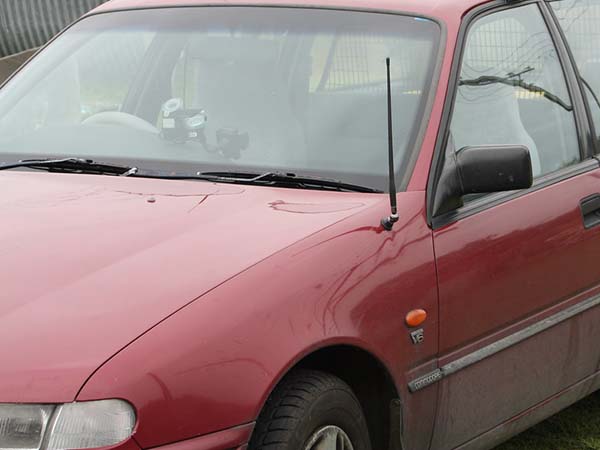
Older and some current vehicles use a traditional whip or telescoping mast mounted on the fender or another exterior location. These are generally the easiest to replace.
Other vehicles use a fixed roof antenna, often called a "shark-fin" antenna. These assemblies can contain multiple antenna functions and may be more complicated to replace.
Some vehicles use antennas integrated into the glass or other parts of the vehicle. Generally, handle these systems according to the manufacturer's repair procedures.
Tip: Check your owner's manual before removing an antenna assembly. It can help you determine whether the antenna is a simple replaceable mast or part of a more complex system.
Step 2: Inspect the Damage
Carefully examine the antenna and its mounting point.
If a traditional metal mast is bent but remains securely attached, you may be able to straighten it carefully. However, don't force a severely bent mast because repeated bending can weaken the metal and cause it to snap.
If the mast is broken, missing, badly corroded, or loose at the mounting point, replacement is usually the better option.
Also inspect the area around the antenna for cracked plastic, damaged paint, water intrusion, or loose hardware.
Step 3: Check the Connection
Before replacing the antenna, make sure the connection is secure.
For an accessible traditional antenna, inspect the connection for dirt, corrosion, looseness, or visible damage. A poor connection can cause weak reception even when the antenna itself appears to be in good condition.
If you need to access wiring behind interior trim, work carefully. Modern vehicles can have wiring, clips, airbags, and electronic components in areas that aren't obvious.
Safety Tip: If you need to remove trim near airbags or other electrical components, consult the vehicle's service information rather than pulling panels apart without knowing what's behind them.
Step 4: Straighten a Slightly Bent Antenna
If your traditional antenna mast is only slightly bent and hasn't cracked or kinked, you may be able to straighten it by hand.
Work slowly and use gentle, even pressure. Avoid bending the mast sharply back into position, as that can weaken the metal.
If the antenna has a significant kink or appears damaged at the base, replacement is generally safer than reshaping it.
Step 5: Remove a Damaged Antenna
If the antenna needs replacing, locate the mounting hardware.
On a traditional external antenna, you may be able to remove the mast or antenna assembly from outside the vehicle using the appropriate wrench or screwdriver.
Some wrenches screw into a base, while others connect to wiring you must access from inside the vehicle.
Don't pull forcefully on the antenna if it doesn't come free. You could damage the mounting point, wiring, or surrounding bodywork.
Step 6: Install the Replacement
Before installing the new antenna, make sure it's compatible with your vehicle.
Connect the antenna securely and reinstall any mounting hardware according to the manufacturer's instructions. Make sure the antenna sits properly against the vehicle and that any gasket or seal is correctly positioned.
A loose antenna can cause poor reception and may allow water into the mounting area.
Don't overtighten the mounting hardware. Excessive force can damage threads, plastic components, or the vehicle's body panel.
Step 7: Clean the Antenna and Mounting Area
Once the antenna is installed, clean away dirt and road grime around the base.
Keeping the mounting area clean can help you spot corrosion, loose hardware, or water intrusion before they become bigger problems.
For telescoping antennas, keep the mast clean and follow the manufacturer's maintenance recommendations. Avoid applying random household oils or lubricants, which may attract dirt or interfere with the antenna's operation.
Step 8: Test Your Radio
Turn on the vehicle's radio and test several stations.
Check both strong local stations and weaker stations to determine whether reception has improved. If the radio still has significant static or poor reception, the antenna may not be the only issue.
Possible causes include:
Damaged antenna wiring
A loose connection
Corrosion at the antenna base
A faulty antenna amplifier
A damaged coaxial cable
A problem with the radio itself
Electrical interference from another vehicle component
If replacing the antenna doesn't resolve the problem, you may need further diagnosis.
What About Power Antennas?
Some vehicles have motorized power antennas that automatically extend when the radio is turned on and retract when it is turned off.
If a power antenna stops moving, the problem may involve the mast, motor, gears, wiring, switch, fuse, or control circuit.
Don't force a power antenna up or down. Doing so can damage the mechanism.
If the motor operates but the mast doesn't move, the internal mechanism may be damaged. Depending on the vehicle, replacing the mast or the entire power antenna assembly may be the most practical solution.
What About Shark-Fin Antennas?
Modern vehicles frequently use low-profile roof-mounted antennas, commonly known as shark-fin antennas.
These may support more than traditional AM/FM radio. Depending on the vehicle, an antenna assembly may support satellite radio, GPS, cellular communication, or other connected services.
Because of this, replacing a shark-fin antenna isn't always as simple as replacing a traditional metal mast.
If the housing is damaged or you notice problems with multiple communication features, check the vehicle's service information or have a qualified technician inspect the system.
When Should You Replace the Antenna Instead of Repairing It?
Repairing a car antenna makes sense when the problem is minor, such as dirt, a loose connection, or a slightly bent traditional mast.
Replacement is usually the better choice when:
The antenna is broken
The mast has a severe kink
The antenna is heavily corroded
The mounting hardware is damaged
The antenna no longer provides reliable reception
The internal mechanism of a power antenna has failed
The antenna housing has cracked
The wiring or connector is damaged
A replacement antenna is often relatively inexpensive for a traditional mast, making repair attempts unnecessary when the component is clearly beyond repair.
How to Prevent Future Antenna Damage
A little preventative care can extend the life of your antenna.
Keep the antenna clean, especially in winter, when road salt and grime can build up around the base. Be cautious with automatic car washes, especially if your vehicle has a tall or retractable antenna.
If your antenna is removable, follow the vehicle manufacturer's recommendations regarding removal before entering a car wash.
Don't use the antenna as a handle, and avoid placing objects against it when loading or unloading the vehicle.
If you notice corrosion or looseness around the antenna base, address the problem early rather than waiting until the antenna breaks.
A damaged car antenna doesn't always require an expensive repair. Traditional external antenna masts can often be inspected, cleaned, straightened when only slightly bent, or replaced with the right tools and a compatible replacement part.
However, modern vehicles may use more sophisticated antenna systems that support radio, navigation, satellite, cellular, and other connectivity features. In those cases, what looks like a simple antenna problem may require professional diagnosis.
Start by identifying the type of antenna your vehicle uses, inspect the damage carefully, and check the connections before replacing anything. If a traditional antenna is clearly broken, replacement is often the simplest solution.
Taking care of your antenna and addressing minor problems early can help maintain reliable reception and keep a small exterior issue from becoming a bigger repair.