
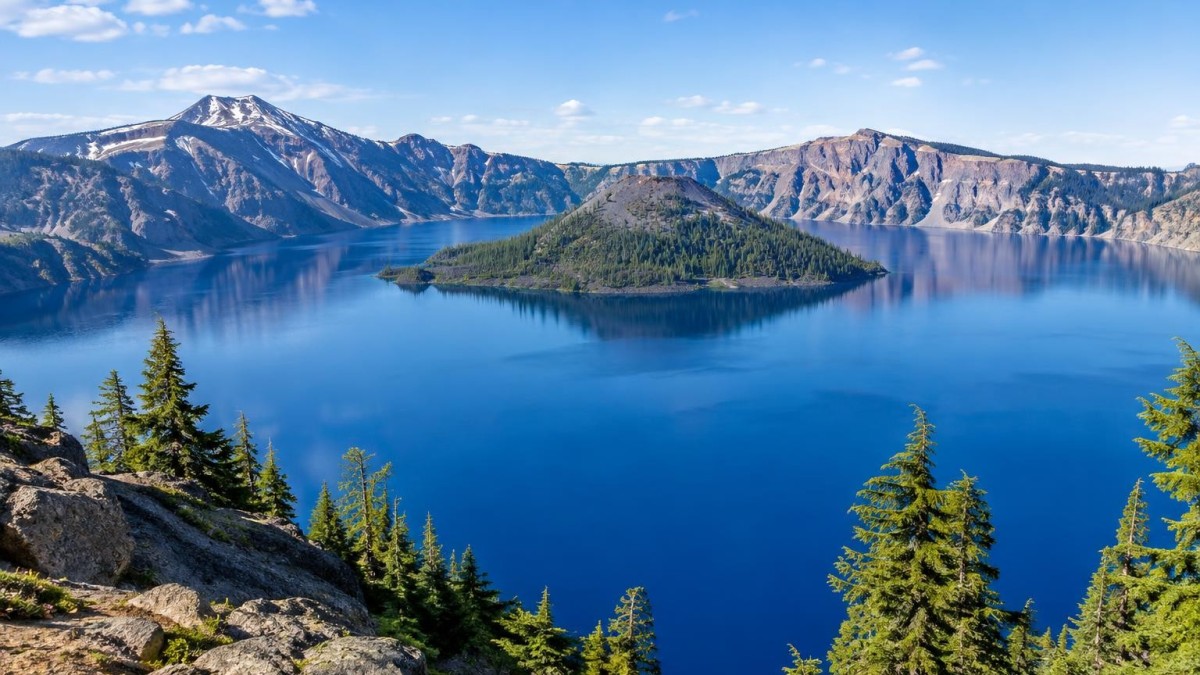
| Location | Oregon, USA |
|---|---|
| Site Type | Caldera lake |
| Known For | Deepest lake in the U.S. |
| Established as a National Park | 1902 |
| Maximum Depth | 1,949 feet (594 meters) |
Crater Lake’s stunning blue waters and sheer cliffs are a captivating sight today, but their origins trace back roughly 7,700 years to a powerful volcanic event that reshaped the landscape of southern Oregon. At the heart of this story is Mount Mazama, a towering stratovolcano that once dominated the region and whose violent collapse birthed one of America’s most extraordinary natural landmarks.
The Fiery Birth of a Lake
Mount Mazama was a massive volcano that stood over 12,000 feet tall and was part of the Cascade Range. Around 5700 BCE, it erupted in one of the largest volcanic events in North America’s recent history. This catastrophic eruption expelled ash and lava, emptying the magma chamber beneath the mountain. Without support underneath, the volcano’s summit collapsed inward, forming a deep, bowl-shaped caldera nearly 6 miles wide and up to 2,000 feet deep.
Over the centuries, precipitation and snowmelt gradually filled the caldera, creating the crystal-clear lake we see today. The lake’s clarity is a result of its lack of inflowing rivers, which limits sediment and pollutants. Crater Lake is the deepest lake in the United States and the ninth deepest worldwide, reaching nearly 2,000 feet at its lowest point.
Distinctive Features and Enduring Significance
The sheer walls of the caldera rise dramatically around the lake, creating jaw-dropping vistas that draw visitors from across the globe. One of the lake’s iconic features is Wizard Island, a volcanic cinder cone that emerged from the lake’s surface after the collapse. Its dark silhouette contrasts starkly with the vibrant blues of the water.
Beyond its breathtaking beauty, Crater Lake holds cultural importance for Native American tribes, who have long regarded it as a sacred site. The lake’s formation story and the surrounding landscape are woven into tribal legends and traditions.
Designated as a national park in 1902, Crater Lake preserves a unique natural laboratory for geology, ecology, and climatology studies while offering visitors unforgettable experiences through hiking, boat tours, and stargazing under some of the clearest skies in the country.
Newsletter Station provides professionally written, ready-to-send newsletters customized for your market and brand.
EXPLORE NEWSLETTER OPTIONS