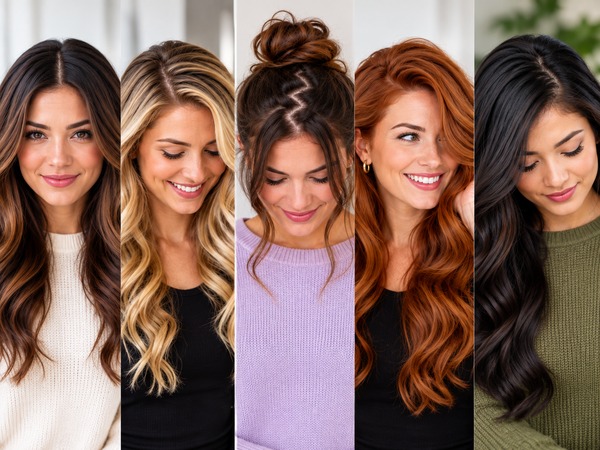
You don't necessarily need a new haircut or color to make your hair look different. Sometimes moving your part an inch—or even less—is enough to change the shape of your hairstyle.
Your hair part affects how your hair falls around your face, where volume appears, and which features are emphasized. Changing it can also reveal volume that gets flattened when hair is worn in exactly the same position every day.
The trick is knowing how to persuade your hair to cooperate. Hair develops familiar growth patterns, so a new part may initially want to spring back into its usual position. A little water, heat, and strategic styling can usually help.
Here are five easy hair-part ideas to try when you're ready for a change.
- Try a Clean Middle Part
The middle part has become a modern staple because it creates a balanced, polished look without requiring complicated styling.
To make one, use the pointed end of a rat-tail comb to draw a line from the center of your forehead toward the crown. For a softer, less precise look, use your finger instead.
A center part can work with straight, wavy, curly, and coily hair, although the finished effect will naturally differ depending on texture and haircut.
Try it with loose waves, a sleek low ponytail, a bun, or hair worn naturally. If your hair tends to lie flat at the roots, add a small amount of volumizing product before drying.
Don't worry if the line isn't perfectly straight. A slightly imperfect part often looks more relaxed and natural.
- Move to a Soft Side Part
A side part can change your hairstyle without making it feel dramatically different.
Instead of starting directly in the center, move your part an inch or two to either side. This shifts some hair across the top of the head, which can create the appearance of additional volume.
A soft side part works particularly well when you want something versatile enough for both everyday wear and more polished occasions.
For a dressier look, add loose waves or tuck the lighter side behind your ear. For something casual, let the hair fall naturally and use your fingers rather than a comb to create the part.
Experiment with both sides. Many people automatically part their hair in one direction for years without ever checking how the opposite side looks.
- Have Fun With a Zigzag Part
The zigzag part is a playful option when a straight line feels too predictable.
Use the pointed end of a rat-tail comb to move from side to side as you work backward from the hairline, then gently separate the sections. The zigzag can be subtle or dramatic depending on how far you move the comb with each turn.
This style can work especially well with ponytails, braids, buns, pigtails, and other styles where the part itself is visible.
There's also a practical benefit: an irregular part can make the scalp less noticeable than a perfectly straight line in some hairstyles.
If you're trying this for the first time, start with a loose zigzag rather than making lots of tiny turns. It's quicker to create and usually easier to style.
- Create Volume With a Deep Side Part
If your usual hairstyle feels flat, try moving your part farther to one side.
A deep side part transfers considerably more hair across the top of your head, creating instant lift and a more dramatic silhouette. It pairs particularly well with waves, curls, bobs, long layers, ponytails, and updos.
For extra volume, create the part while your hair is damp. Apply an appropriate volumizing product near the roots and blow-dry the hair in its new direction. If you use a blow dryer or other hot styling tool, use heat protectant and avoid excessive heat.
For an easy evening style, create a deep part, add soft waves, and tuck the less-full side behind your ear.
One caution: don't force a severely deep part if your hair strongly resists it. Cowlicks and natural growth patterns can determine where hair wants to separate, and working with them often produces a better result than fighting them.
- Experiment With a Diagonal Part
A diagonal part offers a middle ground between a center part and a dramatic side part.
Instead of drawing a straight line from front to back, start the part toward one side of your hairline and angle it gradually toward the center or opposite direction as you move toward the crown.
The result creates subtle asymmetry without necessarily looking like an obvious styling trick.
Diagonal parts can also be useful when you're creating ponytails, buns, braids, or half-up styles because they add visual interest when the top of the head is exposed.
Try different angles rather than assuming there's one "correct" diagonal. A small change in direction can noticeably alter how the front layers frame your face.
How to Train Your Hair to Part Differently
Sometimes choosing a new part is easy. Getting your hair to stay there is another matter.
Hair that's been parted in the same place for a long time may naturally fall back into that position. Cowlicks, curls, hair density, and growth direction can also influence where a part wants to sit.
The easiest time to establish a new part is usually when the hair is damp.
Create the part where you want it, apply your normal styling products, and dry your hair in that direction. If you blow-dry, directing the roots away from their usual position can help reset how the hair lies.
Clips can also help hold sections in place while hair cools or air-dries.
Give the new position a little time. You may need to style it consistently for several days before it begins to feel natural.
Don't Choose a Part Based Only on Face-Shape Rules
You'll often see advice claiming that a particular face shape must wear a center part while another should always have a side part.
Those rules are far from absolute.
Your haircut, hairline, texture, density, curl pattern, cowlicks, and personal preferences can matter just as much as face shape. Two people with similarly shaped faces can look completely different with the same part because their hair behaves differently.
Use face-shape suggestions as ideas to experiment with, not rules you have to follow.
The easiest test is also the most useful one: try several parts and take photos from the front and side. Seeing the styles in pictures can make subtle differences much easier to notice.
A Small Change Can Make Your Hair Feel New
Changing your hair part is one of the lowest-commitment ways to refresh your hairstyle. There's no waiting for a haircut to grow out and no color to maintain.
Start small. Move your usual part slightly to the side, switch sides completely, or try a center part for the day. If you're heading somewhere special, experiment beforehand rather than discovering five minutes before leaving that your hair strongly prefers its old position.
And if the new look isn't for you, simply move the part back.
That's what makes this particular hairstyle update so useful: you can change your mind tomorrow.